 Big
Big  Should your person be reading this instead?
How Far in Advance Should You Plan a Proposal?
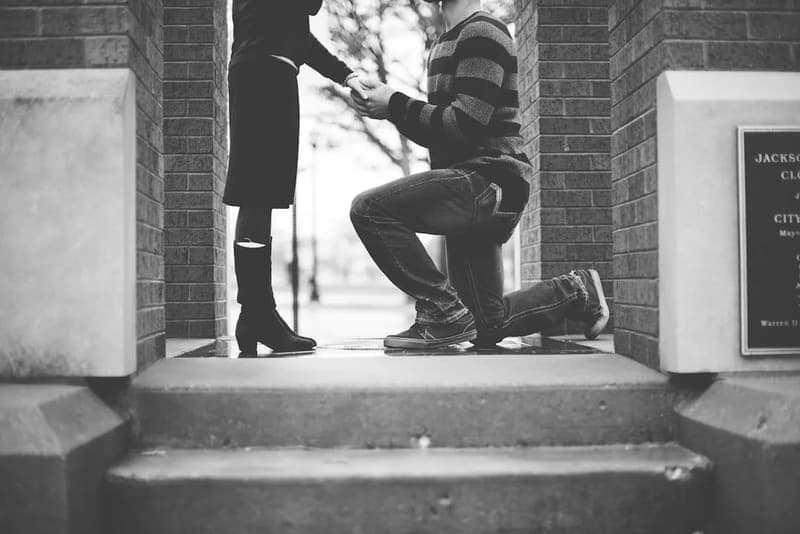
Three months.
That is the honest answer for most proposals, and it has very little to do with how long it takes you to feel ready.
It takes about three months because you do not control most of the calendar. The jeweler does. The park office does. The restaurant does. The photographer does. The weather does, and you cannot see far enough ahead to plan around it anyway.
You can propose well in two weeks. Plenty of people do, and there is a section below for you. But you will be choosing from whatever is still available, and if you are proposing in December, there is not much left.
This post is about when. What to actually do is a separate question, and it starts with her rather than with a list of ideas. So is what not to do: the ten mistakes that keep happening.
Here is what actually sets the clock, working backwards from the day you want to ask.
Almost everyone plans, and it is still a surprise
There is a persistent idea that planning ruins the magic. The data says otherwise.
In The Knot's 2024 Jewelry and Engagement Study, which surveyed more than 7,800 US couples, 83% of proposers prepared in advance. Only 13% described their proposal as spontaneous. Just under half of the ones who planned spent one to three months on it.
And on the other side of the question, 83% of proposees still called it a surprise. More than half of that group said they knew a proposal was coming, they just did not know when.
That is the useful distinction. The surprise almost never comes from the question. It comes from the timing.
The same study found 57% of couples had discussed engagement more than a year before it happened, and 77% of proposees had some involvement in choosing the ring, whether that meant hinting, shopping together, or standing there when it was bought.
You are not surprising her with the idea of marriage. You are surprising her with a Tuesday.
Twelve weeks out: the ring sets your earliest possible date
The ring is the longest lead time in the whole project, and it is the one people underestimate.
Three in four proposers in The Knot's study spent about four months shopping for the ring. That is shopping, before anything gets made. The average price paid was $5,200.
Two things eat time here, and neither is the browsing.
The first is production. If the ring is made to order, set with a stone that has to be sourced, or altered in any way, it ships on the jeweler's schedule, not yours. Get that date in writing before you commit to a proposal date, and treat their estimate as the earliest, not the latest.
The second is sizing, which is where good plans quietly fall apart. Resizing is a second trip through the workshop, and the free window is shorter than people assume. Brilliant Earth, to take one published example, gives one complimentary resize within 60 days regardless of sizing range, or up to a year if the change is within their range, and that clock starts when the ring is first available to ship, not when you propose.
So if you buy in September and propose at Christmas, most of your free resize window is gone before she has ever worn it.
Read your own jeweler's policy. It is one paragraph, and it tells you whether you need her real size or can get away with close.
Eight weeks out: find out if your location needs permission
Most people never think to check. Usually it does not matter. When it does, it matters a lot, because the answer is a form and a waiting period, not a conversation on the day.
For national parks, the National Park Service rule is clearer than you would expect. No permit is needed for still photography involving eight or fewer people, as long as the activity happens in areas open to the public, uses hand-carried equipment only, does not require exclusive use of a site, does not adversely impact park resources or other visitors, and is not likely to create extra administrative costs for the park.
Read that list again, because a proposal can break it easily. A hired photographer with a tripod and a light. Ten family members hidden behind a rock. Standing on an overlook and asking other visitors to wait.
The NPS applies the same rule to commercial, non-commercial and student photography. Hiring someone is not what triggers the permit. The size and footprint of what you are doing is.
For a sense of the timescales once a permit is involved, Yosemite requires a special use permit for any wedding or commitment ceremony anywhere in the park, charges $150, and will schedule it up to a year in advance but no later than 21 days before the event.
A proposal is not a wedding ceremony, so that exact rule may not apply to you. The lead time is the point. If your location needs paperwork, three weeks is the floor, not the target.
So if the spot is a park, a garden, a historic house, a rooftop, or anywhere with a name and an office, call the office. Ask two questions. Do I need a permit for what I am describing, and how long does it take.
Six weeks out: if you are proposing in December, you are in traffic
December is the most popular month to get engaged, accounting for 19% of all proposals, with December 25 the single most popular date, according to The Knot. About 47% of couples get engaged between November and February.
So nearly half of every proposal in the country lands in a four-month window, and the ring workshops, the photographers and the good tables are all being competed for at once.
One in five proposers hires a secret photographer, and 5% bring in other vendors like musicians or videographers. In our experience, those are the bookings that disappear first in December, and the ones people leave latest.
If your date falls in that window, add weeks. If it does not, you have more room than you think, and better attention from everyone you are asking for help.
Three weeks out: choose the time from a sunset table
If any part of this happens outdoors, the light is not a mood you can wing. It is a published number.
The US Naval Observatory runs a free tool that gives exact sunrise, sunset and twilight times for any date and location. It takes about thirty seconds to use.
The number that matters more than sunset is the end of civil twilight, which the USNO defines as the moment the center of the Sun sits 6 degrees below the horizon. After that, ordinary outdoor activity normally needs artificial light. Photographs stop working. Faces stop reading.
So your workable window is not "around sunset." It is the stretch between the light going warm and civil twilight ending, and depending on your latitude and the month, that can be shorter than half an hour.
Look it up for your exact date. Then plan to be standing in the right place fifteen minutes early, because the one thing you cannot ask the sun to do is wait.
One week out: this is when the weather first becomes real
People try to plan weather two months ahead. It cannot be done, and knowing why saves you a lot of anxiety.
NOAA is blunt about it. A five-day forecast is accurate about 90% of the time. A seven-day forecast is accurate about 80% of the time. A ten-day or longer forecast is right about half the time, which is another way of saying it is a coin toss.
Beyond a week, what exists is not a forecast. NOAA's Climate Prediction Center publishes 6 to 10 day and 8 to 14 day outlooks, issued daily, giving the probability of above or below normal temperature and precipitation. Useful for a hunch. Useless for deciding whether to kneel on grass.
So pick your date without the weather. Choose an indoor backup at the same time. Then look properly at seven days out, again at five, and again the night before.
A backup is not pessimism. It is the thing that lets you enjoy the last week instead of refreshing an app.
The week of: six questions worth writing down
Not thinking about. Writing down, somewhere you can look at it while your hands are shaking.
- Where is the ring for every hour of that day, and who is the last person to touch it before you do?
- If someone is photographing, what is the signal, where are they standing, and what do they do if you move?
- Who knows in advance, and what exactly have you asked them not to do?
- What happens in the ten minutes after she says yes? Somewhere to sit. Something to drink. A phone with battery.
- What is the backup location, and at what time do you decide to use it?
- Who are you calling first, and does she get to choose that?
That last one matters more than people expect. The Knot's data shows 53% of proposals happen with nobody else present and 39% happen somewhere public. Either is fine. But the first ten minutes afterwards belong to both of you, and it is worth knowing whether she wants to sit in silence or ring her sister immediately.
For what it is worth, 69% of proposers asked a parent for permission or a blessing first. That is still the norm rather than the exception, and it is a conversation with its own lead time if the parent lives somewhere else.
What if you only have two weeks?
Then you cut in a specific order.
Solve the ring first, even if that means a temporary ring or a setting you have both looked at. Keep the location simple and permit-free, which usually means somewhere private rather than somewhere impressive. Keep the timing tied to a sunset you have actually looked up. Drop the photographer, the musicians and anything that requires a stranger to be in the right place at the right minute.
Two weeks is enough for a proposal that feels considered. It is not enough for a proposal with moving parts. Choose accordingly and it will still be the good version.
A harder question: how long should you have been together?
This one has actual research behind it, and the finding is not what the wedding industry sells.
Economists Andrew Francis-Tan and Hugo Mialon surveyed 3,151 ever-married American adults and published the results in Economic Inquiry in 2015. Two findings are worth your attention.
Couples who dated three or more years before the proposal had a lower hazard of divorce than couples who dated less than a year. That held after controlling for income, age, education and a long list of other characteristics.
And among men, spending between $2,000 and $4,000 on an engagement ring was associated with roughly 1.3 times the hazard of divorce compared with spending between $500 and $2,000.
Be careful with that second one. It is an association, not a cause. No marriage is being ended by a ring. The authors are explicit that their data is self-reported, collected online in 2014, and that better research is needed. The plausible reading is that whatever pressure produces an expensive ring also produces financial stress, and financial stress is the part with the track record.
It belongs in a planning article because it points at where your effort is best spent. Time together and attention are what the evidence likes. The size of the stone is not.
The timeline, all in one place
- Twelve weeks out
Settle the ring. Get the production date and the resize policy in writing.
Pick the location and the approximate date, and check whether the location needs permission.
- Eight weeks out
Submit any permit application. Book the photographer if you want one.
Have the family conversation if you are having one, since that person may need to travel or keep a secret for two months.
- Four weeks out
Confirm the ring is on schedule. Confirm the reservation. Confirm the backup location.
Look up sunset and the end of civil twilight for your exact date and place, then set the actual hour.
- One week out
First real weather check. Reconfirm every person involved.
Write down the six questions and their answers. Charge everything.
- The day
Arrive early. Know where the ring is. Say the three true things you meant to say, then stop talking.
Nothing else on the list is what she will remember.
If you would rather hand this list to someone
Every item on this list is easy. Holding all of them at once, while also being the nervous one, is not.
This is the part we do for a living. You answer questions about the two of you, and the plan comes back built around your actual relationship: the place, the timing, the sequence, the backup, and the words, with the logistics written out so you are not carrying them alone.
Have a look at how it works.
Plan your proposal with usA few questions about the two of you; the plan is built from your answers.
Ready to plan your own big moment? Start with a birthday or the Big Q. Or let the date night membership build you one every month, venue and timing included.