 Big
Big  Should your person be reading this instead?
The Hardest Part of a Long-Distance Relationship Isn't the Distance

Yes, long-distance relationships can work. Couples who live apart often report as much relationship satisfaction as couples who live near each other, and some studies find more intimacy. The bigger risks are idealizing each other, hard reunions, distracted calls and running out of things to share.
There is a very specific sadness that comes with leaving someone you love at an airport.
You spend four days doing ordinary things together. You eat breakfast. You argue about where to park. You fall asleep beside each other. Then, suddenly, your relationship is back inside a phone.
People love to warn long-distance couples that their relationship probably will not work. Usually, they say it with the confidence of someone who has never looked at the research.
The research does not say that distance automatically destroys relationships.
In fact, long-distance couples often report just as much relationship satisfaction as couples who live near each other. Some studies have even found that they experience more intimacy.
That does not mean long distance is easy. It means the real problems are more specific than “you live too far apart.”
They are also problems you can do something about.
Are long-distance relationships common?
Yes. According to an analysis of American Community Survey data by the National Center for Family & Marriage Research, 12.5% of newlyweds were living separately from their spouse in 2023.
That share has more than doubled since 1980, when census data put it at 5.7%.
Among newlyweds between the ages of 15 and 24, more than one in four were living apart. Researchers studying college relationships have estimated that on residential campuses, somewhere between 25% and 50% involve long distance.
So no, you are not attempting some statistically impossible form of romance.
Plenty of couples are figuring out how to love someone they cannot see every day.
The better question is not, “Can long distance work?”
It is, “What makes it work?”
Distance can make couples more intentional
Researchers Crystal Jiang and Jeffrey Hancock asked long-distance and geographically close couples to record their interactions for a week.
The couples produced more than 3,000 entries.
The long-distance couples communicated less frequently, but they reported greater intimacy. They disclosed more about themselves and felt that their partners were opening up more in return.
That makes sense when you think about it.
Couples who live together can spend an entire night in the same room while barely interacting. One person watches television while the other scrolls. Technically, they are together.
Long-distance couples do not get to rely on physical proximity. Every call, message and visit has to be chosen.
That effort can become an advantage.
It is the voice note you record from a grocery store parking lot because the story is too long to type. It is explaining your office drama so thoroughly that your partner develops strong opinions about a coworker they have never met.
It is letting someone into the small, forgettable parts of your day.
The danger comes when you only share the polished parts.
The reunion may be harder than the distance
This is the finding more couples should know about.
Researchers Laura Stafford, Andy Merolla and Janessa Castle studied college students whose long-distance relationships became geographically close.
About 36.7% of those relationships ended after the reunion. Of the ones that ended, roughly two-thirds did so within the first three months of living near each other.
They survived the distance. They struggled once the distance was gone.
One explanation is idealization. When you only see someone during planned calls and anticipated visits, it is easy to build a slightly edited version of them in your mind.
You see the person who misses you, dresses for the airport and plans exciting weekends.
You do not always see the person who leaves dishes beside the sink, becomes quiet after work or needs an entire Sunday afternoon alone.
Then you move in together and meet the unedited version.
This does not mean long-distance couples should become cynical. It means they should make room for ordinary life before they close the distance.
Call while you are folding laundry. Stay on video while you both make dinner. Let your partner see the bad mood that does not have an interesting explanation.
Being known is more useful than always being impressive.
Visits can create an emotional hangover
Many long-distance couples recognize this pattern:
You have an amazing visit. The goodbye is awful, but manageable. Then, two days later, one of you becomes irritable, distant or unexpectedly emotional.
Sometimes it turns into a fight that seems to come from nowhere.
Researchers have called this “relationship jet lag.”
Studies suggest that reuniting is usually the easy part. Couples are excited to see each other, and that excitement carries them through the transition.
Separating again is harder.
Your body and routines have adjusted to having your partner nearby. Then the visit ends and you are expected to return immediately to normal life.
It can help to plan for this instead of treating it like evidence that something is wrong.
Before your next visit ends:
- Decide when you will speak again.
- Make plans for the first day or two apart.
- Spend time with a friend or family member.
- Put the next visit on the calendar, even if the details are not final.
A goodbye feels different when it has an end date attached to it.
Your phone is carrying the entire relationship
For couples who live together, a distracting phone can interrupt dinner.
For long-distance couples, the phone is dinner.
It is the date, the conversation, the television screen and sometimes the only way you get to look at each other that week.
That makes divided attention especially painful.
Researchers use the word “technoference” to describe everyday moments when technology interrupts couple time. Higher levels of these interruptions have been associated with more conflict and lower relationship satisfaction.
In a long-distance relationship, you can be on a video call and still feel completely alone because your partner is reading something in another window.
The answer is not constant access or surveillance. Location sharing, repeated check-ins and detailed questioning may briefly soothe anxiety, but they do not automatically create trust.
Instead, agree on simple rules about attention.
Maybe neither person uses a second screen during the first 30 minutes of a date. Maybe difficult conversations happen on video instead of through text. Maybe you tell each other about plans before being asked, not because permission is required, but because inclusion feels good.
The goal is not to account for every minute.
It is to help your partner feel like they still have a place in your life.
What does long distance cost?
Long-distance couples spend real money maintaining their relationships.
A 2026 survey commissioned by the moving company Mayflower asked Americans who were not yet living with their partner but expected to within five years. The long-distance couples among them had spent an average of $6,888 combined on travel over the course of their relationships.
That is not a small expense.
It is flights, gas, train tickets, airport food, pet care, missed shifts and last-minute price increases. It is paying $340 at 2 a.m. because the cheaper flight leaves before sunrise.
Money can become a source of resentment when couples avoid discussing it.
One person may earn more. One may have better access to an airport. One may be able to take time off more easily. The financial burden can quietly become uneven until it comes out during an argument that appears to be about something else.
A simple visit budget can prevent this.
Decide how frequently you want to see each other, what you can realistically afford and how expenses will be divided. You might each contribute to a shared travel fund every month, even when no trip is currently booked.
A fund with nothing named against it is an easy one to raid. Writing down what you are saving towards is one of the jobs a shared bucket list does.
You should also be careful not to move in together only because travel has become expensive.
Closing the distance is a relationship decision, not an airline pricing strategy.
Small moments matter more than impressive gestures
Long-distance couples often place enormous pressure on visits, anniversaries and scheduled date nights.
Those things matter, but they are not the entire relationship.
Relationship researcher John Gottman studied how partners responded to small attempts at connection, which he called “bids.”
A bid can be as simple as: “Look at this dog.” “This reminded me of you.” “You will not believe what happened at work.”
Driver and Gottman's 2004 study in Family Process filmed 49 newlywed couples through a single dinner. The couples who bid warmly over the meal, and answered each other, were the same couples who kept some humor and affection going in a recorded argument afterwards. It is one meal, 49 couples, and the authors say the design cannot show cause.
The important moments were not necessarily dramatic or romantic.
They were small attempts to connect that the other person noticed and answered.
That is especially good news for long-distance couples. Distance can stop you from sharing a meal, but it cannot stop you from showing genuine interest in a photo, a joke or a half-finished thought.
The slow danger is not always a lack of love.
It is when every conversation becomes a status report: How was your day? Fine. Yours? Fine. Tired. Talk tomorrow?
That is communication, but it is not necessarily connection.
Routines are not always rituals
“We talk every night at nine” sounds romantic until the call begins to feel like another task to complete.
Researchers studying couple rituals have found that shared rituals are associated with greater relationship satisfaction.
The distinction between a routine and a ritual is meaning.
A routine is something you regularly do.
A ritual is something you both recognize as belonging to your relationship.
Watching television together every Thursday can become background noise. But choosing a show that neither person watches alone, ordering the same snack and sending each other a rating afterward gives the night a shape.
The activity does not need to be elaborate.
It just needs to feel intentional.
Five things to try this week
- Have one deliberately ordinary call
Do not wait until you are dressed, interesting and ready to perform.
Call while making dinner, cleaning your room or walking home. Give your partner access to the version of you that exists between the highlights.
- Respond to the small messages
That photo or strange thought your partner sent may look insignificant, but it was still an attempt to connect.
You do not need to craft a perfect response. A quick, genuine reply is better than leaving it unanswered because you planned to respond properly later.
- Write down the plan for closing the distance
Talk about whether you want to live together, where that might happen and what each of you would need to do first.
You do not need every answer today. An imperfect shared plan is still more reassuring than two private assumptions.
- Plan for the days after a visit
Do not plan only for the fun part.
Schedule something supportive for the first 48 hours after you separate again. Decide when you will call. Try to discuss your next visit before the current one ends.
- Turn your next call into an actual date
Do something with a beginning, middle and end.
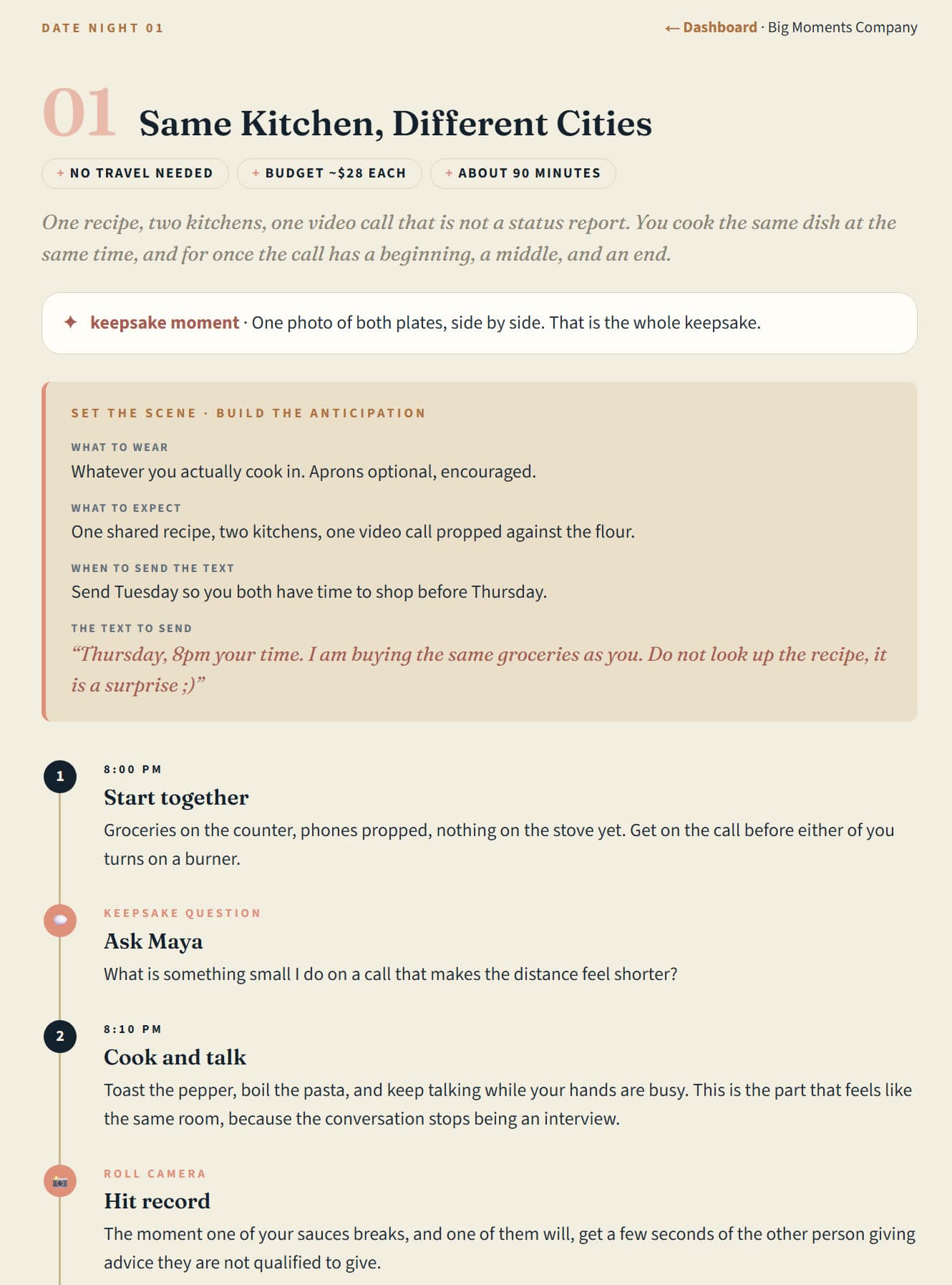
Cook the same meal. Complete a challenge. Compare childhood photos. Make a playlist for each other. Watch something neither of you has seen and talk about it afterward.
Then save one thing from the night. A screenshot. A photo. A ridiculous quote. A song.
Long-distance couples create thousands of messages, but surprisingly few physical or lasting reminders of the time they spent together.
Why we built Big Moments for couples who live apart
Coming up with something meaningful every week is difficult, especially when both people are tired and another video call starts to feel like an obligation.
That is one reason we built Big Moments.
Big Moments plans the dates for you, so the night has a shape instead of starting with two tired people asking each other what they want to do. Premium members also get the Newlywed Game, which the two of you can play from different cities, taking turns on your own phones while we email whoever is up next.
If you are still deciding what to install, we sorted sixteen apps for long-distance couples by whether they need you both awake at the same moment, with what each one costs.
Our keepsakes help couples save something from the night, so a date becomes more than another call that disappears into the week.
Readers can currently try one month of Big Moments Premium free. No card is required.
Claim your free month of Big Moments PremiumJust your email. No card, no commitment.
Is long distance doomed?
No, but it is difficult. The miles are real.
The cost is real.
Missing someone during an ordinary Tuesday night is real.
But the idea that long-distance relationships simply “never work” is not supported by the research.
Couples tend to struggle with identifiable things: idealizing each other, failing to prepare for transitions, becoming distracted during the limited time they share, avoiding money conversations and letting communication turn into a repetitive status update.
Those problems deserve attention.
They are not proof that your relationship is impossible.
Distance is not always what causes couples to lose each other.
Sometimes it is the slow drift that happens when two people stop finding ways to participate in each other's lives.
And that is something you can begin changing tonight.
Research referenced
- National Center for Family & Marriage Research, Bowling Green State University, “Married and Living Apart Together.”
- Jiang, L. C., and Hancock, J. T., “Absence Makes the Communication Grow Fonder.”
- Stafford, L., Merolla, A. J., and Castle, J. D., “When Long-Distance Dating Partners Become Geographically Close.”
- Weber, D. M., et al., “Relationship ‘Jet Lag’ in Long-Distance and Geographically Close Relationships.”
- McDaniel, B. T., and Coyne, S. M., “‘Technoference’: The Interference of Technology in Couple Relationships.”
- Garcia-Rada, X., Sezer, O., and Norton, M. I., “Rituals and Nuptials.”
- Driver, J. L., and Gottman, J. M., “Daily Marital Interactions and Positive Affect During Marital Conflict Among Newlywed Couples,” Family Process 43, 301–314 (2004).
- Talker Research for Mayflower, “The Long-Distance Tipping Point.”
Want the planning handled? Pick a birthday plan, a proposal plan, or monthly date nights that arrive with the places, the timing and a backup.