 Big
Big  Should your person be reading this instead?
What Moving to a New City Does to a Couple
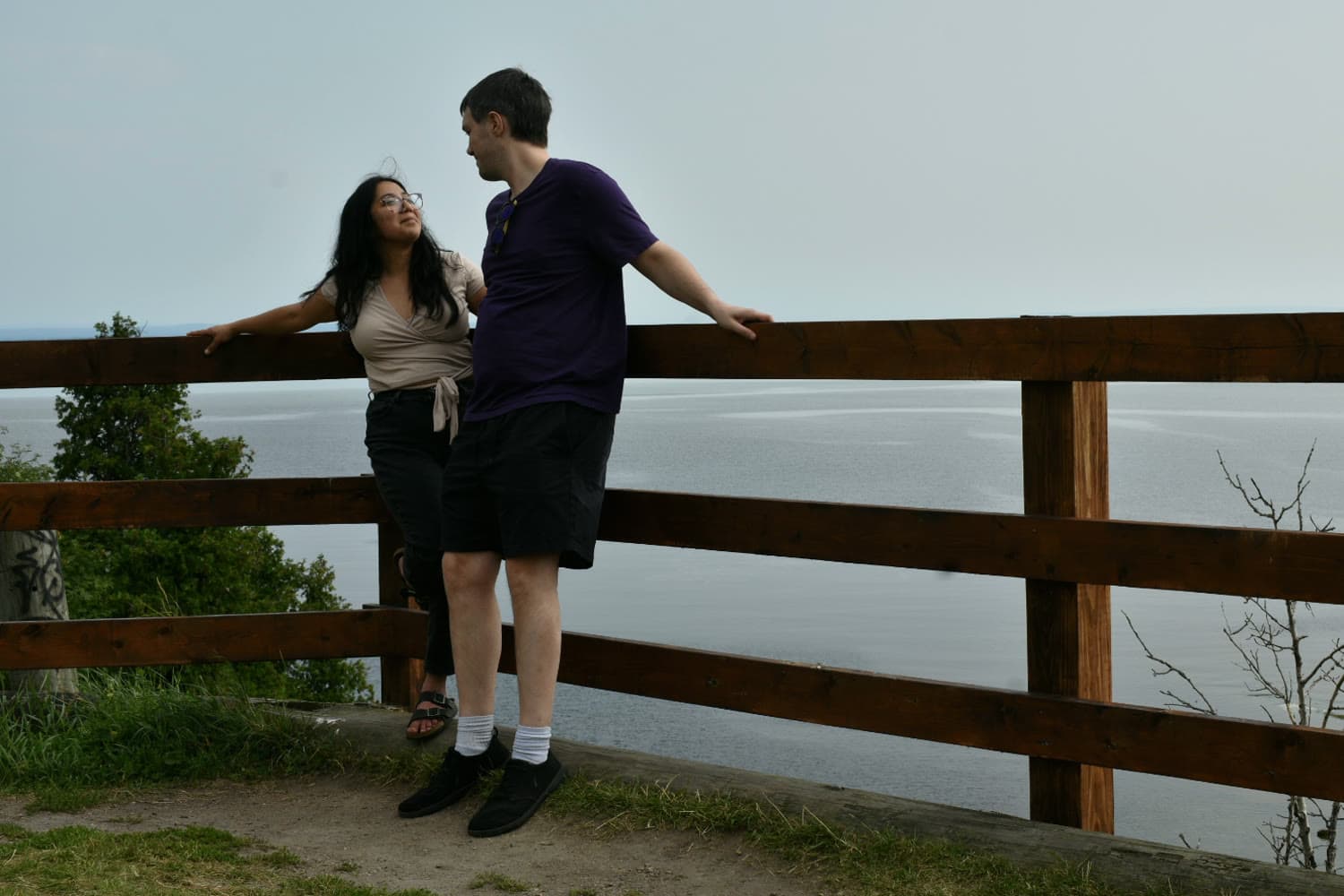
I went to school in Burlington, Vermont, and I have never quite gotten over the place.
It is the largest city in Vermont, which tells you more about Vermont than it does about Burlington. There is a lake, a street closed to cars, a serious winter, and a shorter list of things to do than I wanted by the time I was finished. I loved it. I also ran out of it.
When I left, that was how it worked. You lived where the work was, and a place you loved but could not work in became a place you visited.
The volume of moving has not changed much since. The Census Bureau put the 2024 mover rate at 11.8 percent, down from 12.1 percent the year before, and 13.3 percent of workers worked from home, itself down a little from 2023. What changed is that for some of us the question of where to live came unbundled from the question of where to work. Once it is unbundled, you get to ask it more than once.
I work remotely now and I split my year between Pittsburgh and Montreal. Two apartments, two grocery stores, two sets of Friday nights, two cities full of people who have no idea who I am.
I also run a company that plans dates for couples, so I pay close attention to what happens to a couple's week when the map underneath it changes. When you move, your relationship keeps every bit of its history and loses all of its infrastructure. The restaurant where they know your order is gone. The friends who used to text on a Thursday are several states behind you. The thing you did on Sundays does not exist here yet.
You are the same two people. Your week is a blank page.
There is good research on what that first year does to a couple, and it is far more specific than anything that surfaces when you search for help with it.

What the first year after a move does to a couple
In 2026, Hanieh Naeimi and colleagues published a study in Personality and Social Psychology Bulletin that followed 206 couples through a relocation. They surveyed people two months before the move, then again at three, six, nine and twelve months after it. Three hundred and eighty three people, rating twelve different parts of the experience: careers, social networks, living arrangements, the logistics of the whole thing.
Most of the headline is reassuring. Stress went down. General stress, career strain, the ache of moving away from family, housing worry and the logistics all declined across the first year. Several of the good parts grew. Financial stability improved, and so did the sense of building social ties.
The rewards that came from novelty declined first. The rewards that came from belonging took the whole year to arrive.
Rewards tied to the new job and to exploring a new culture went down over the twelve months, while the rewards tied to putting down roots climbed. And a few stressors never really faded: the disruption to their social lives, and the work of navigating an unfamiliar culture, sat about where they started.
Put those together and the first year has a shape. The first weeks are interesting. Everything is a small adventure, including the parking. Then the interesting part wears off, the belonging has not arrived yet, and you are standing in your own kitchen on a Saturday afternoon with nothing on the calendar and nobody to call.
That is the gap. It is on schedule, and it is the part you can prepare for.
Two caveats. These were couples who moved for work or study, three quarters of them without children, most reporting high relationship satisfaction before they went. And the study watched couples over time rather than assigning them to conditions, so it describes what tends to happen, not what causes what.
How long it takes to make one friend
Jeffrey Hall, at the University of Kansas, put a number on how long that takes.
One of his studies surveyed 355 adults who had moved within the previous six months and were trying to make friends. Another followed 112 first year students through their opening weeks on campus. The pattern held across both. Somewhere around 40 to 60 hours together turns an acquaintance into a casual friend. Around 80 to 100 makes them a friend. More than 200 before you would call anyone close.
Hall is specific about which hours count. Hanging around, joking, playing something and doing an activity side by side all move people closer. Hours spent working together count for much less.
Do that arithmetic against your own new city. Meet someone once a week for two hours and fifty hours is most of a year.
Nobody moves somewhere expecting friendship to take a year of Tuesdays.
These are averages from two American samples, and they are estimates rather than deadlines. Some people click in a month.
If month five feels flat, that is what five months feels like.
Your partner cannot be the entire calendar
The social disruption of a move does not clear quickly, and new friendships take hundreds of hours to build. So for the first several months, one person is your default plan for every evening, every weekend and every time something goes wrong. The relationship carries the whole load.
That is a great deal to ask of it, and it changes the texture of ordinary time together. Date night stops being the good part of the week and becomes the only part. Small disagreements get more air than they deserve, because there is nowhere else for the evening to go.
When you had friends and regulars, your weekend largely planned itself. Somebody had a birthday. Somebody had a recommendation. The trivia thing was on Wednesday whether or not either of you had the energy to think of it.
None of that machinery exists in a new city yet, and it does not assemble itself. For a while you have to do by hand what your old city was doing for you for free.
A new city hands you one real advantage, and it expires
Arthur Aron and colleagues published a set of studies in 2000 on what happens when couples do something new together.
They ran a newspaper questionnaire, a door to door survey and three laboratory experiments. In the surveys, couples who reported more shared exciting activities also reported more satisfaction, with relationship boredom explaining much of the link. Those parts were correlational, so they show an association rather than a cause.
In the experiments, couples did either a seven minute novel and physically engaging task together or a more mundane one, and rated their relationship before and after. The couples given the novel task reported a bigger lift in relationship quality, and a control group that did nothing showed the lift came from the task rather than from simply spending the time.
Seven minutes in a laboratory is not a year in Montreal, and it would be dishonest to stretch it that far. Doing something new together lifts how the relationship feels, right then.
That is the one thing a new city gives you for nothing. Right after you move, almost everything qualifies: the bakery, the bus route, the long walk you take because you got lost.
And the relocation study says that window closes. The novelty rewards were the ones that declined. So the advantage is real, it is temporary, and it is easy to spend it on unpacking.

The first ninety days, as a plan
It comes down to about six decisions, made early, while everything is still easy.
- Pick two regulars before you pick a favorite
A coffee place and somewhere to eat, chosen in week one on convenience rather than quality, and then visited weekly. Go often enough that somebody starts recognizing you.
- Put one new thing a week on the calendar, in writing
This is the novelty window, and it will not survive being decided at seven on a Friday when you are both tired. Choose it on Sunday. Anything counts while you are new: a neighborhood neither of you has walked, a restaurant serving food you cannot pronounce, the museum that is free on Thursday evenings.
- Split the map, then report back
Go in different directions on your own and each bring back one place. It doubles your coverage of the city, and it gives each of you your own relationship with it instead of one shared opinion. It is also the cheapest way to stop being each other's only company.
- Book one thing that repeats and involves strangers
A class with a term, a league with a season, a volunteer shift with a rota, a run club that meets on the same morning. Hours are the currency, and an evening that never happens again pays almost none of them. If fifty hours is the price of one casual friend, you want something that bills you weekly.
- Say yes for the first six months
Every invitation, including the ones that sound mediocre, including the coworker's partner's birthday. For half a year the goal is volume rather than fit, because you are building the pool you will later get to choose from. Get selective in month seven.
- Keep something from the first month
Photos, the ticket from the first show, the receipt from the night you got the parking badly wrong. The first month somewhere is the one you will most want back later, and it is the one that leaves the least behind, because you were busy and nothing yet felt like an occasion.
What we have done with it
Burlington was the first place I loved and left. Pittsburgh and Montreal are what I do now, and I only get to do it because my work no longer cares where I sit.
Splitting a year between two cities sounds like the answer to everything, and mostly it is. It also means being new twice, on a schedule. Every time we switch there is a stretch of days where neither of us knows what to do on a Saturday, and I have stopped reading that as a sign of anything except a change of address.
In August, Ian and I took the first getaway our own software ever planned. Four days, the fourteenth to the seventeenth, driving from Montreal up to Quebec City and then out to Tadoussac. We filmed that weekend.
It was a real test rather than a demonstration. The plan itself held up. The part where you save the trip did not. Our own tool for capturing a moment failed on us for three days, which is how we found out it had been quietly failing for everybody else too. We rebuilt it when we got home.

Why our app has a home base you can change
The reason Big Moments lets you move is that I kept needing to.
In your settings there is a field for where you live. It drives three things: the local events we surface, the city your date plans are built around, and the getaway matcher. Move, or spend a month somewhere else, and you change that one field. Everything downstream repoints to the new place.
Events near you is the part that earns its keep when you are new. Concerts, markets, tastings, shows and festivals near your postcode, checked a couple of times a week, pulled from two sources so the neighborhood market turns up alongside the arena show. When you do not know anybody yet and you do not know what is on, having a list at all is the hard part. Free members see the next few. Members see everything, plus a date night designed around the ones they pick.
And our keepsakes exist for the first month problem. They hold on to what a night was, so the year you spent being new somewhere leaves something behind.
Claim your free month of Big Moments PremiumJust your email. No card, no commitment.
Give it the year
Moving somewhere new with a person you love is one of the more romantic things two people can do, and for about five months it does not feel that way.
The excitement drains out before the belonging arrives, and the friendships that will make the place yours are still a few hundred hours away. None of that means you chose badly.
Put the new thing on the calendar, go back to the same coffee shop until they know you, and give it the year.
Research referenced
- Naeimi, H., Park, H. G., Johnson, M. D., Visserman, M. L., Horne, R., and Impett, E. A., “On the Move: Trajectories of Stressors and Rewards Among Relocating Couples,” Personality and Social Psychology Bulletin (2026).
- Hall, J. A., “How Many Hours Does It Take to Make a Friend?” Journal of Social and Personal Relationships (2019), with the sample details and hour figures as reported by the University of Kansas.
- Aron, A., Norman, C. C., Aron, E. N., McKenna, C., and Heyman, R. E., “Couples' Shared Participation in Novel and Arousing Activities and Experienced Relationship Quality,” Journal of Personality and Social Psychology 78(2), 273 to 284 (2000).
- U.S. Census Bureau, American Community Survey 1-year estimates, geographic mobility and commuting characteristics (2024).
Moving as a couple, answered
How long does it take to feel at home in a new city?
Longer than most people plan for. In a study of 206 couples who relocated, the sense of having built social ties kept climbing across the entire first year, while the excitement of the move faded early. Friendship research points the same way: roughly 40 to 60 hours together turns an acquaintance into a casual friend, and more than 200 before you would call someone close. Feeling flat around month five is on schedule.
Is moving hard on a relationship?
It is stressful in ways that mostly ease. In that same study, most relocation stress declined over the first year, including general stress, housing and logistics. Two things did not fade much: the disruption to your social life and the work of adjusting to a new culture. The pressure on the relationship comes less from the move itself and more from the months when your partner is your only plan.
What should we do first as a couple in a new city?
Choose two places you will return to every week before you go hunting for the best in town, and put one new thing on the calendar each week while everything still counts as new. Familiarity and novelty are both cheaper to come by in your first month than they will be in your sixth.
How do you meet people in a new city as a couple?
Commit to something that repeats and involves other people: a class with a term, a league with a season, a volunteer shift with a rota. Friendship research suggests closeness is built out of hours spent together, and an evening that never happens again pays almost none of them. A weekly room does.
Ready to plan your own big moment? Start with a birthday or the Big Q. Or let the date night membership build you one every month, venue and timing included.